Redesigning XOi’s equipment data foundation to prevent unreliable records from affecting downstream products

I created a shared data-quality system that prevented bad records from entering the platform and helped administrators repair existing data
9:41
Site Survey
Finish workflow
Provide a data plate Image
Capture with your camera or upload an image
Check for a match before adding new equipment.
A duplicate can impact lifecycle history and
maintenance recommendations
Existing equipment at this site
RTU-01
View Details
Serial number
CX35-30/36B-6F-20
Model number
1519K09200
Age
6yrs
Make
trane
Inactive equipment (1)
RTU-05
Replaced by RTU-03
CX35-30/36B-6F-20
Add new equipment
My work
Knowledge
Search
Settings
9:41
RTU-05
⚠️
Replaced unit
This unit was replaced on Jan 20, 2025 and is no longer active. Continue work on RTU-03
Replace unit with RTU-03
RTU-05
Replaced by RTU-03
Serial number
CX35-30/36B-6F-20
Model number
1519K09200
Age
6yrs
Make
trane
Last activity
Last scanned Jan 20, 2025 · 11:43
Scanned by D. Okonkwo
Something is wrong with the equipment?
Report a problem to admin
My work
Knowledge
Search
Settings
9:41

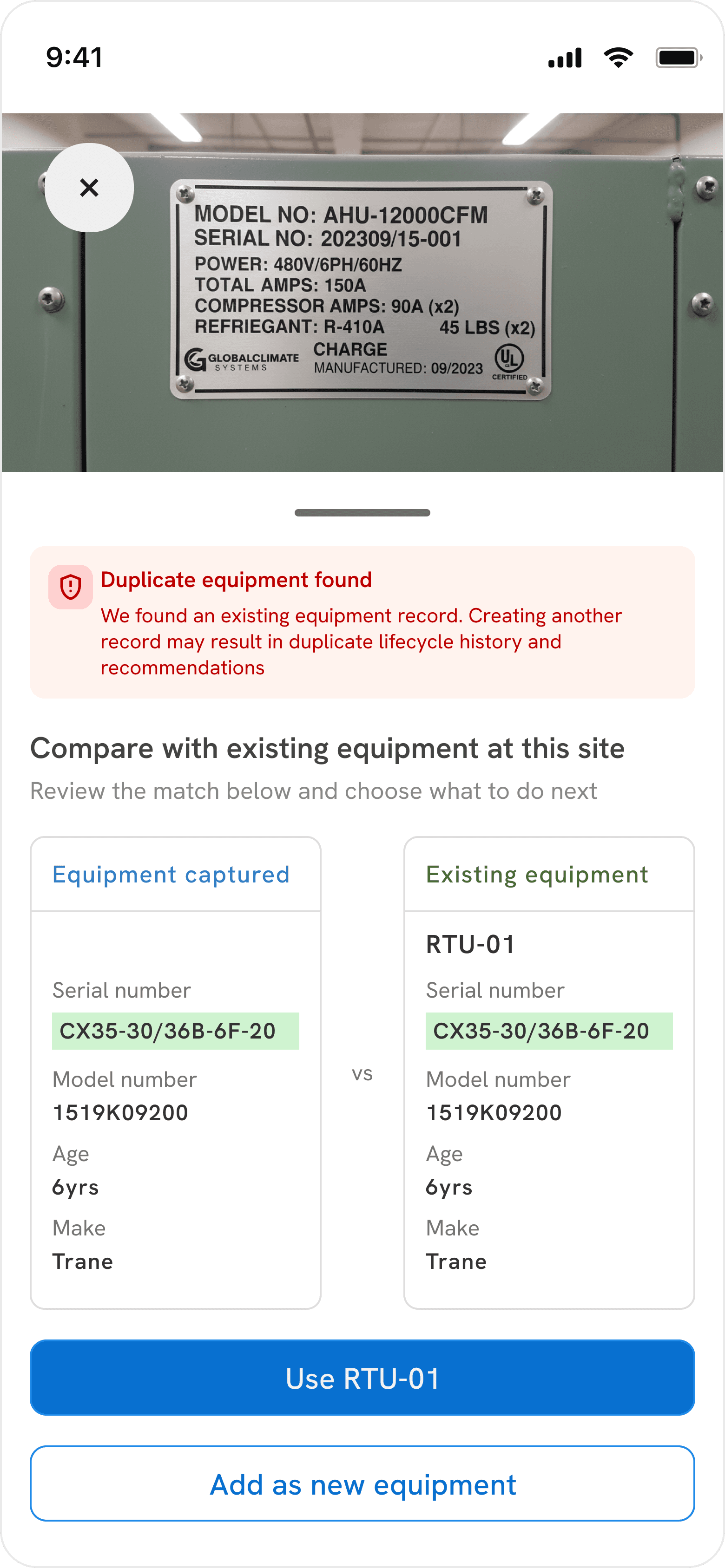
Duplicate equipment found
We found an existing equipment record. Creating another record may result in duplicate lifecycle history and recommendations
Compare with existing equipment at this site
Review the match below and choose what to do next
Equipment captured
RTU-01
Serial number
CX35-30/36B-6F-20
Model number
1519K09200
Age
6yrs
Make
trane
vs
Existing equipment
RTU-01
Serial number
CX35-30/36B-6F-20
Model number
1519K09200
Age
6yrs
Make
trane
Use RTU-01
Add as new equipment
9:41
Add Equipment
Add unit names to continue

Unit Name
*
e.g RTU1
Serial number
CX35-30/36B-6F-20
Model number
1519K09200
Age
6yrs
Make
trane
Location
Rooftop
Replaced By
RTU-03
Save
My work
Knowledge
Search
Settings
Why we started redesigning equipment
data foundation?
Nearly half of the equipment data entering
the platform bypassed meaningful validation
One unreliable equipment record could distort maintenance
recommendations and capital plans
Duplicate equipment captured could lead to an inaccurate downstream recommendation loosing admins trust

Duplicate equipment added into the maintenance quote

Incorrect quote being generated for the maintenance with duplicate equipment
Before: technicians could not reliably distinguish active, replaced, and duplicate equipment
Lack of visibility of existing equipment


Equipment added into the system without validation


The problem extended across three connected workflows, not just OCR
I led cross functional meetings with customer success, product manager and data scientists to join me in evaluating the platform
The problem was not limited to OCR
Bad data entered through three connected workflows
Mapping the ecosystem
It revealed that isolated feature fixes would not protect the platform

Because we could not redesign the entire platform at once, I proposed a phased data-quality strategy
I organized the work into 3 phases balancing urgency, technical complexity, existing customer workflows, engineering effort, and downstream risks
Instead of blocking possible duplicates, I gave technicians enough context to make an informed decision
Automatically blocking all suspected duplicates could create false positives and prevent technicians from adding legitimate new equipment
9:41
RTU-05
⚠️
Replaced unit
This unit was replaced on Jan 20, 2025 and is no longer active. Continue work on RTU-03
Replace unit with RTU-03
RTU-05
Replaced by RTU-03
Serial number
CX35-30/36B-6F-20
Model number
1519K09200
Age
6yrs
Make
trane
Location
Rooftop
Replaced By
RTU-03
Last activity
Last scanned Jan 20, 2025 · 11:43
Scanned by D. Okonkwo
Something is wrong with the equipment?
Report a problem to admin
My work
Knowledge
Search
Settings
9:41
Duplicate equipment found
We found an existing equipment record. Creating another record may result in duplicate lifecycle history and recommendations
Compare with existing equipment at this site
Review the match below and choose what to do next
From dataplate
RTU-01
Serial number
CX35-30/36B-6F-20
Model number
1519K09200
Age
6yrs
Make
trane
vs
Existing equipment
RTU-01
Serial number
CX35-30/36B-6F-20
Model number
1519K09200
Age
6yrs
Make
trane
Use RTU-01
Add as new equipment
I designed admin review workflows to catch corrupted data before it propagated the system


Testing revealed that preventing duplicate records also saved technicians time in the field
"I had 15 units to capture. I opened the camera, and seeing the existing equipment right there helped me know what was already in the system and what still needed to be added."
Field technician
Equipment data went from a liability to a
foundation the product could build on
The high-fidelity screens shown here are part of a personal practice exercise. After the initial project shipped, I chose to redesign the entire interface on my own to explore how a refreshed design system and improved visual hierarchy could elevate the final product. Detailed case study is liked here